Why Federal Law Separated Packers from Livestock Auctions
In my previous post, I discussed a proposal in the House Agriculture Committee’s version of the 2026 Farm Bill that could change a long-standing regulation under the Packers and Stockyards Act. The proposal—known as A-PLUS (Amplifying Processing of Livestock in the United States)—would allow livestock auctions to participate in certain smaller packing operations.
To understand why that proposal is significant, it helps to understand why federal law separated packers and livestock markets in the first place.
The rule is not an arbitrary regulatory technicality. It reflects more than a century of experience with market power, conflicts of interest, and the structure of livestock markets in the United States.
The Livestock Market Before Federal Regulation
In the late nineteenth and early twentieth centuries, livestock marketing in the United States was undergoing rapid change.
Farmers traditionally sold livestock in small lots to local dealers, who assembled animals and shipped them to large terminal stockyards in cities such as Chicago, Kansas City, and Omaha. As transportation improved, many producers began shipping livestock directly to these terminal markets themselves.
When they arrived, producers encountered a highly concentrated industry dominated by a handful of very large meatpacking companies.
These companies were known collectively as the “Big Five” packers: Swift, Armour, Morris, Cudahy and Wilson. Together, these firms controlled the majority of livestock slaughter in the United States and wielded enormous influence over livestock markets.
The Federal Trade Commission Investigation
Concern about the power of the large packers eventually prompted federal investigation.
In 1917, President Woodrow Wilson directed the Federal Trade Commission to conduct a comprehensive investigation of the meatpacking industry. The investigation sought to determine whether monopolies, conspiracies, or restraints of trade existed within the industry.
The FTC’s report, issued in 1918, was highly critical of the dominant packers. Investigators concluded that the Big Five exercised extensive control over both the purchase of livestock and the distribution of meat products.
According to the report, the major packers did not simply operate packing plants. They also owned or controlled key infrastructure within the livestock marketing system, including stockyards, railroad transportation networks, cold-storage facilities, and wholesale distribution channels.
The report concluded that this control allowed the packers to manipulate markets, restrict the flow of food products, and influence both livestock prices and meat prices.
These findings heightened concerns among livestock producers and policymakers that the packers exercised too much influence over the marketing system.
The 1920 Packer Consent Decree
At roughly the same time that Congress was debating legislation to regulate the livestock industry, the U.S. Department of Justice brought an antitrust action against the major packers.
The case was resolved in 1920 through what became known as the Packer Consent Decree. Under the decree, the major packing companies agreed to divest their interests in several sectors of the food distribution system.
Among other restrictions, the packers were prohibited from owning or controlling public stockyards and certain related marketing facilities.
The purpose of these restrictions was to prevent packers from dominating both sides of the livestock marketplace—buying livestock while simultaneously controlling the markets where those animals were sold.
Although the decree addressed immediate antitrust concerns, many policymakers believed broader legislation was still necessary.
Passage of the Packers and Stockyards Act
In 1921, Congress enacted the Packers and Stockyards Act, one of the most important regulatory statutes governing agricultural markets in the United States.
The law was designed to promote:
fair competition in livestock marketing
transparency in market transactions
protection of livestock producers from unfair practices
Congress relied heavily on the findings of the Federal Trade Commission when crafting the legislation. Lawmakers concluded that livestock markets required federal oversight to prevent the types of abuses identified in the FTC investigation.
The Act ultimately created a comprehensive regulatory framework governing packers, livestock dealers, market agencies, stockyards, and live poultry dealers.
The Shift from Terminal Stockyards to Auction Markets
To fully understand why USDA adopted additional structural safeguards in 1954, it is important to consider how livestock marketing itself evolved in the decades following passage of the Act.
At the time the Packers and Stockyards Act was enacted, terminal stockyards were the dominant channel for livestock marketing.
In 1923, terminal markets accounted for approximately:
90% of cattle
86% of calves
76% of hogs
85% of sheep and lambs
sold to packers.
That dominance, however, began to decline soon afterward.
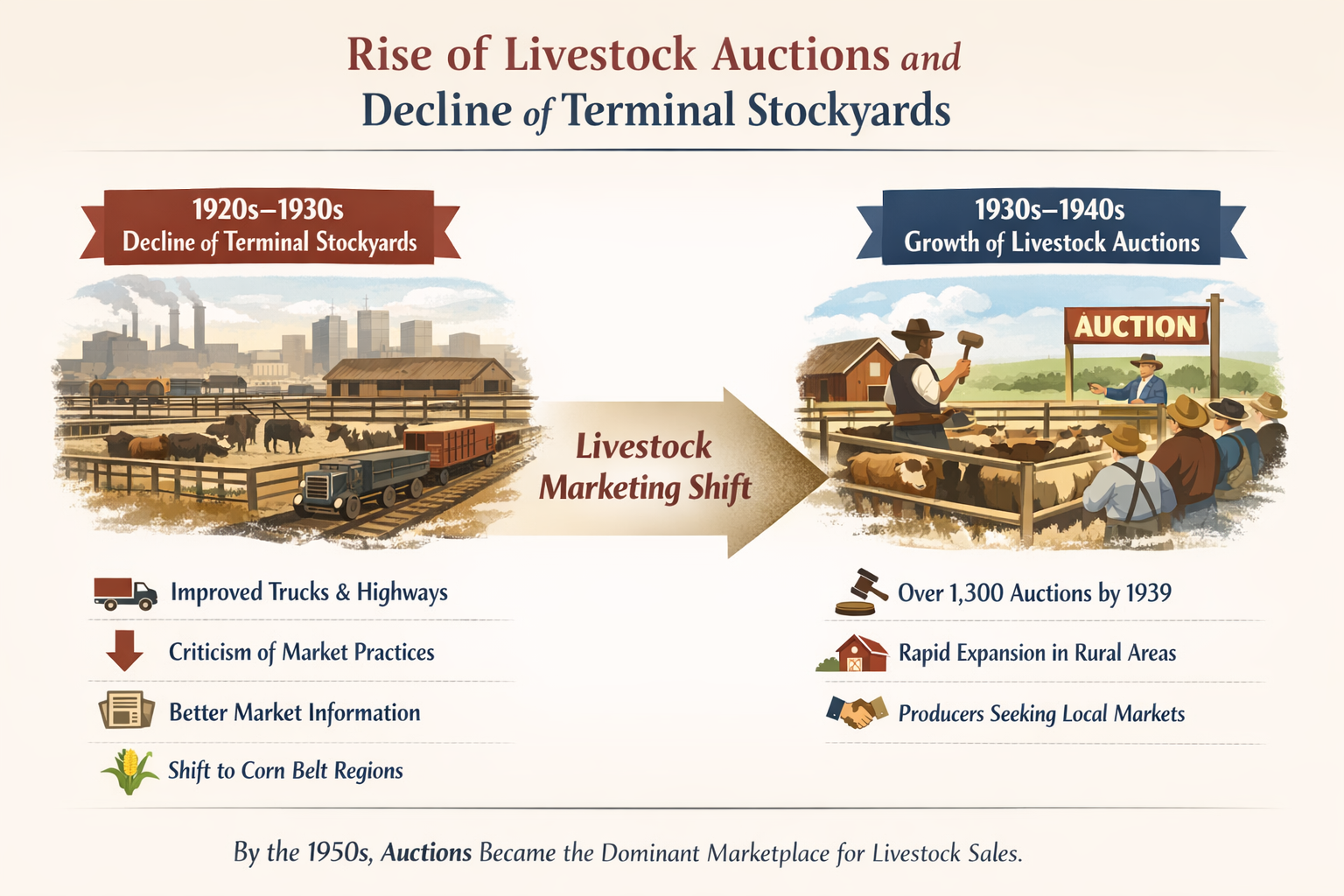
During the 1920s and 1930s, several developments reshaped livestock marketing in the United States. Improved trucking and highway systems made it easier to move livestock directly to buyers. Producers and policymakers also grew increasingly critical of marketing charges and practices at terminal markets, particularly in the period following World War I when livestock prices were under pressure. At the same time, the availability of market information improved through the introduction of government grading systems and expanded market news services. Shifts in livestock production toward corn and other feed-grain regions further altered traditional marketing patterns.
As these changes took hold, livestock auction markets began to emerge as a major alternative to terminal stockyards.
From the mid-1920s through 1939, the number of auction markets expanded dramatically—from only a handful of facilities to more than 1,300 nationwide. Growth was especially pronounced in the north-central United States, which came to host nearly two-thirds of all auction markets.
The trend continued into the 1940s, when the number of auction markets doubled or even tripled in many regions. By the 1950s, auctions had become a central feature of livestock marketing rather than a secondary alternative.
Recognizing this shift, Congress and USDA moved to ensure that these markets were fully subject to federal oversight. In 1958, the statutory limitation that covered only the large terminal stockyards was lifted and auction markets with less than 20,000 square feet of pen space were brought within the scope of the Packers and Stockyards Act.
The Ownership Separation Rule
As auction markets became the primary venue for livestock sales, the structure of the marketplace changed in an important way.
Unlike terminal stockyards, which operated as centralized hubs, auction markets created a decentralized system of local and regional price discovery. These markets typically operated on a commission basis, acting as agents for livestock sellers.
With this structure, the potential for conflicts of interest became more pronounced if packers were allowed to participate directly in auction operations.
In 1954, the U.S. Department of Agriculture adopted a regulation prohibiting packers from owning, financing, or participating in the management of market agencies selling livestock on commission—the category that includes livestock auctions.
The policy objective was to maintain a clear separation between:
the selling side of the market (auction markets acting on behalf of consignors), and
the buying side of the market (packers purchasing livestock)
USDA concluded that this separation was necessary to prevent conflicts of interest and preserve competitive livestock marketing channels.
In 1984, the Department modified the regulation by removing restrictions on livestock dealers owning or financing market agencies. The core principle of separating packers from livestock auctions, however, remained intact.
Why This History Matters Today
The proposed A-PLUS provision in the current Farm Bill debate would partially relax the long-standing separation between livestock auctions and packers—at least for smaller processing operations.
Supporters believe that allowing auction markets to participate in packing operations could encourage investment in regional processing capacity.
Critics worry that combining the buying and selling sides of the market could revive the very conflicts of interest that earlier policymakers sought to prevent.
Understanding how livestock marketing evolved—from terminal stockyards to decentralized auction markets—helps explain why the separation between packers and market agencies became a central feature of federal regulation.
Next in This Series
In the next post in this series, I will examine the current policy debate surrounding the A-PLUS proposal and explore the potential implications for livestock markets, producers, and industry participants.
